From 0 to 263 AI citations in 90 days
How Lumos applied its own GEO playbook and measured the result with its own product, day by day, over 90 days.
By Pablo Arroyo ·
Lumos was born on January 8, 2026, and our site went live in early February. We are a GEO platform, so our job is getting brands referenced by AI models.
Which is exactly why getting ChatGPT, Gemini and Claude to cite us is not a detail: it is the most direct proof that what we do works. It has been one of the biggest challenges of our first five months, and this is what we learned by measuring ourselves.
Key takeaways
- In 90 days, trylumos.ai went from 0 to a peak of 263 citations in a single day inside ChatGPT, Gemini and Claude responses.
- The turning point was not gradual. There was an exact date when everything changed: May 22, 2026.
- It was not one lucky page: we went from 1 cited page to 22 distinct pages cited on the same day.
- We did it with the same GEO playbook we run for our clients.
- Spoiler: Watch out for Reddit, YouTube, LinkedIn and the famous Blog.
Why we measured this in the first place
When Lumos started, we had an uncomfortable hypothesis: most brands are invisible to AI models. You ask ChatGPT "what are the best X platforms" and your company is simply not there. It does not show up lower down. It does not show up at all.
The problem is that almost nobody measures it. You know your Google ranking, you know your traffic, but you have no idea how many times an AI cites you when a potential buyer asks something. And that is where more and more decisions are being made.
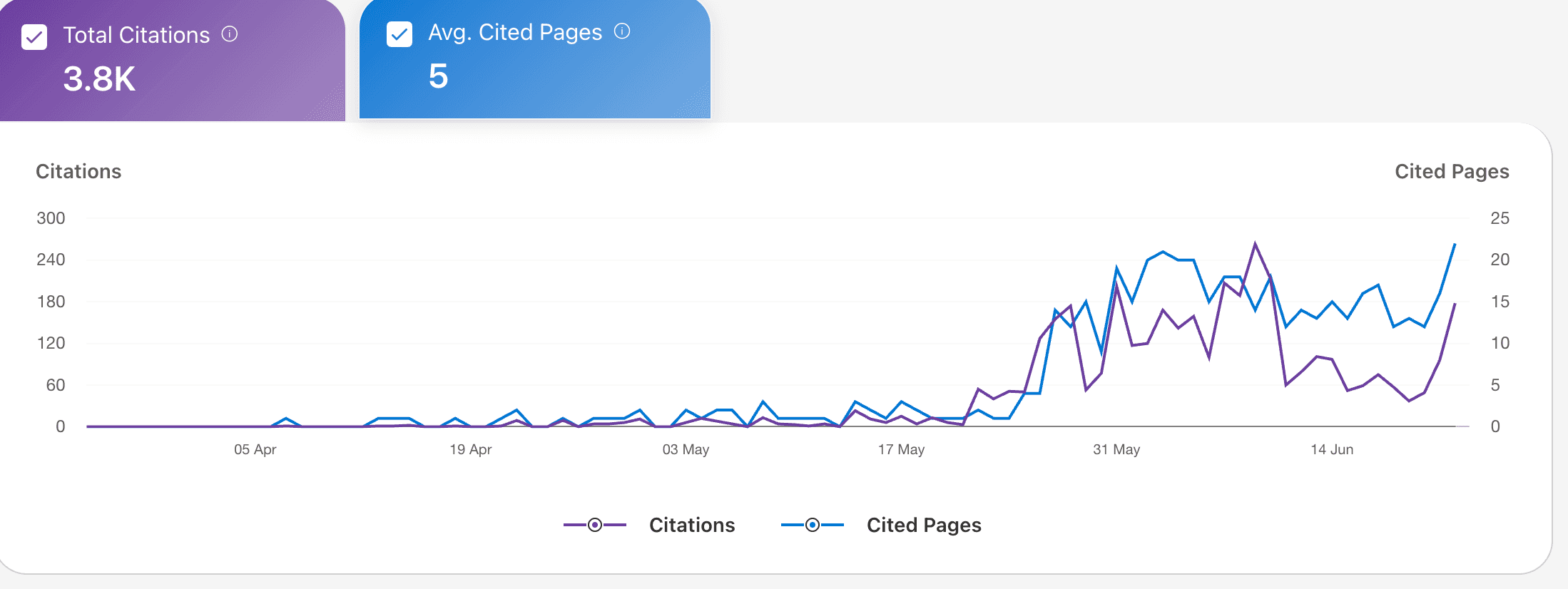
So we decided to be our own case study. We measured every citation of trylumos.ai in AI responses, day by day, since March 25, 2026. Here is what happened.
The short answer: what changed in 90 days
Between March 25 and June 22, 2026, Lumos citations in AI responses went from practically zero to 3,787 cumulative citations over 90 days, with presence on 61 of those 90 days. May generated 22.4 times the citations of April (1,119 vs 50). And by June we were averaging 119 citations a day, with several days above 200.
It was not luck. It was the direct result of making the content citable for a language model, which is different from making it rank on Google.
The 4 phases of takeoff
When you sort the data by day, the story tells itself. There were four clear stages.
Phase 1: the silence (March 25 to April 21)
Almost a full month at zero. Scattered days with 1 or 2 citations, nothing more. Our first recorded citation was on April 7, 2026: a single one, lost in a sea of zeros. This is the phase where most brands are today and do not even know it.
Phase 2: the first signals (April 22 to May 13)
Days with 9, 11, 13 citations started to appear. Still irregular, with zeros in between, but no longer noise. New content was starting to be indexed and referenced by the models.
Phase 3: the warm-up (May 14 to May 21)
This is where it got interesting, though still nerve-racking. For a week citations settled into double digits, but irregularly: 23 one day, 11 the next, then 6, then 15 again. Up and down with no clear pattern.
From the outside it looks small. But what was happening underneath was the important part: the models had started indexing more and more of our pages and testing us as a source. Every time someone asked a category question, there was a real chance they would name us. It was no longer an isolated accident, it was a trend taking shape.
The question we kept asking ourselves was simple: will it hold or will it deflate? The base was already built, citable content, clear structure and enough pages in play. All that was missing was for it to reach critical mass. And it was close.
Phase 4: the explosion (May 22 onward)
It was close, and it hit all at once. On May 22 citations jumped to 54 in a single day and never returned to single digits. From there the curve took off: 127, 155, 174, up to a record peak of 263 citations on June 9.
That jump was not a lucky day. It was the moment when everything we had been building, the citable content, the structure and the trust signals, accumulated until the models started treating us as a reliable source on the topic. Once you cross that threshold, you stop showing up now and then and become part of the default answer.
The number that matters most: it was not a single page
It is easy to get lucky with one URL. The hard part, and what really shows GEO is working, is the diversity of cited pages.
Here the change was just as clear. We started with 1 cited page per day. By late May and June, the models were citing between 12 and 22 distinct pages on the same day, peaking at 22 pages on June 22.
When an AI cites 22 of your distinct pages in a day, you are no longer "that company that came up once". You are a reference source on your category.
That is what moves sales: not showing up once, but being the consistent answer when someone asks.
And not just in AI: Google moved too
The same content we wrote to be citable by AI started generating presence in traditional search. We measured it in Google Search Console and the pattern is the same: impressions were flat for weeks and spiked hard toward late June, right when AI citations exploded.
Google Search Console, trylumos.ai. The same curve as the citations dashboard.
| Metric | Growth |
|---|---|
| Total clicks | x5 |
| Total impressions | x8 |
| Average CTR | x2 |
| Average position | +14 |
We are not fighting for the top Google spots yet, there is plenty of road ahead. But that is not the point: GEO and SEO are not separate boxes. The content that is citable by AI is the same one that starts climbing in search. When you do it right, you win on both fronts with a single move.
What moved the needle
There is no trick, there is a system. This is what we actually did with ourselves.
- Reddit, YouTube, LinkedIn and blog: the winning combo in LatAm. In more developed markets, brands are already used to writing a lot of unique content to rank in SEO and GEO. In LatAm we saw a huge difference: that habit barely exists, which leaves the field much more open. What worked best for us was combining four channels the models read and cite constantly: Reddit, YouTube, LinkedIn and our own blog. That mix is what really moves AI visibility in the region.
- We write about what we know. It sounds obvious, but almost nobody respects it and to me it is the most important one. I love Formula 1 and tennis, but if our blog were about that, the models would have no reason to associate Lumos with GEO. Your site has to be about your thing: everything we publish is about AI visibility, generative search or real cases like this one. When your content and your product point at the same topic, the AI starts treating you as a source for that category instead of noise.
- We write to be cited, not just to rank. Models lift statements that stand on their own. That is why our articles (what is GEO, GEO vs SEO, how to appear in ChatGPT) are built with clear definitions, precise figures and direct answers a model can take and attribute to us as-is.
- We gave it the structure the AI understands. Hierarchical headings, question-and-answer sections and JSON-LD on every page. We applied it to ourselves: the methodology page, the blog and this very case carry the same schema we recommend to clients.
- We covered the whole category, not one keyword. Instead of fighting for a single phrase, we published the entire GEO funnel: the definition, the comparisons, how to audit your visibility and real cases. That is why we ended up with 22 distinct pages cited on the same day, each answering a different question.
- We measured every day, with our own product. Lumos measures itself inside Lumos. That daily measurement is what showed us May 22 was the turning point and told us exactly what to replicate.
What this means for you
If you sell something and your buyers ask an AI before deciding, you are in one of two positions: they cite you or they do not. Today, you are most likely in Phase 1 without knowing it.
The good news is that Phase 1 is not permanent. It took us about 60 days to find the inflection point and another 30 to scale it. With a clear system, it is repeatable.
Frequently asked questions
What is GEO (Generative Engine Optimization)?
GEO is the practice of optimizing your content so generative AI models like ChatGPT, Gemini and Claude cite you in their responses. Unlike traditional SEO, which aims to rank in a list of links, GEO aims to be the source the AI uses and names when it answers a question.
How long does it take to see results in AI citations?
In Lumos’ case, the first citation arrived at 13 days, but the real takeoff took about 60 days from the start of measurement. Results depend on how much citable content you publish and how competitive your category is.
Why does appearing in AI responses matter, not just Google?
More and more buyers do their initial research by asking an AI directly. If the AI does not name you, you are out of consideration before the buyer even reaches Google. Showing up in those answers puts you in the decision from the first moment.
How is AI visibility measured?
It is measured by tracking how often and in what contexts AI models cite your brand or content against real buyer questions. At Lumos we measure daily citations and distinct cited pages to understand not just volume but depth of presence.
In short
We went from 0 to 263 daily citations in 90 days, from 1 to 22 cited pages, and found the exact date everything changed. Not from a trick, but from a system measured day by day.
The first step is knowing whether the AI names you or not.